

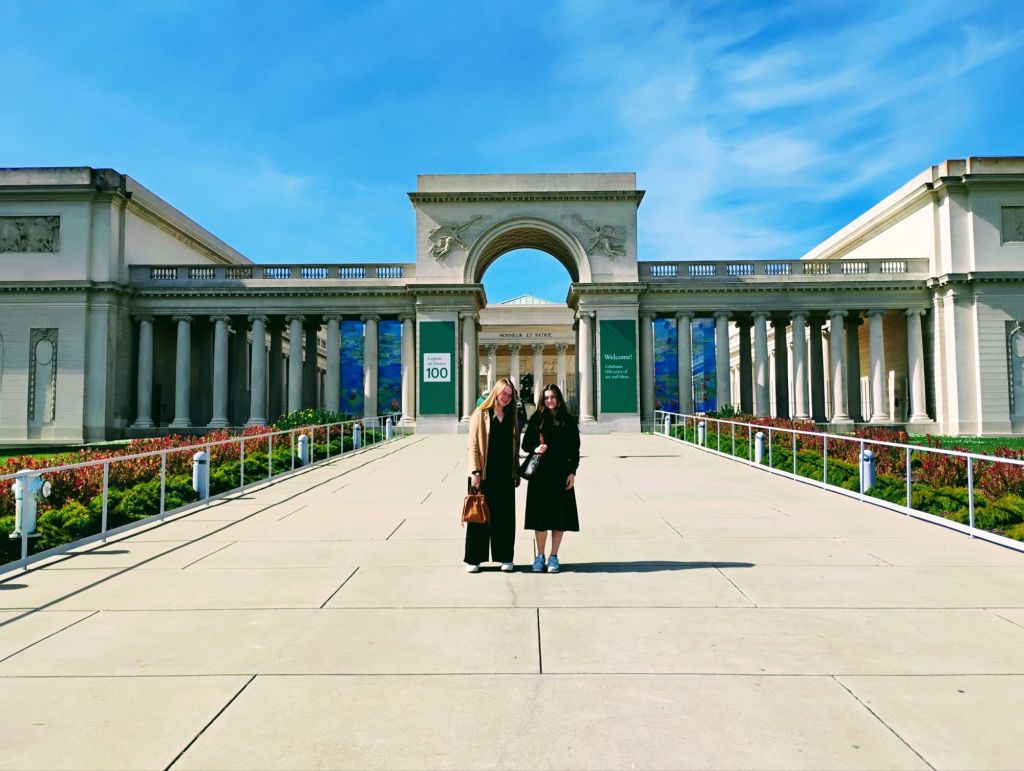


At Fort Point, where Kim Novak throws herself into the Bay. And at the Legion of Honor, where Carlotta’s portrait hangs.

Teach me to care and not to care.
At Fort Point, where Kim Novak throws herself into the Bay. And at the Legion of Honor, where Carlotta’s portrait hangs.
The best version of a thing will not be the most marketable version of that thing. For this reason, there’s no one in classical education who objects to improvements in quality quite like the people selling it.
“Great leaders are great listeners. Great leaders take feedback.”
This might be true, but the sort of leader who posts this sentiment on LinkedIn is not a great leader and is only interested in pleasant, positive, encouraging, tone-sensitive, demure, flattering feedback.
I know this because I checked.



I used to obsess over taking perfect pictures for Facebook.
A school has material needs and it has spiritual needs, and “admin brain” is what happens when the two aren’t rightly divided.
Let me explain.
Administrators are chiefly responsible for the material operation of a school. They must ensure that payroll is met. They must ensure that an adult is present wherever large groups of students are gathered. For legal reasons, they must see that various regulations and requirements are satisfied. A great many of these material concerns merely need fulfilling—it hardly matters how. Administrators do not feel the need to put “their best man” on playground duty. The consistently hungover rookie will do just as well as the brilliant veteran. A light switch which is flipped clumsily will come on just as well as a light switch flipped with grace and style.
So far, so good.
However, a school also has spiritual and intellectual needs, and these needs must be treated very differently than its material needs. “Admin brain” is what happens when the spiritual and intellectual needs of a school are treated like material needs. Here are a few examples:
One. To meet accreditation requirements, a school must have a faculty development program. Administrators cobble together a faculty development program that checks a box but isn’t any good and so every teacher despises it. The administrator knows the faculty development program is bad, but “anything worth doing is worth doing badly.” We’ll fix it later. Besides, the faculty development program doesn’t have to be enjoyable, profound, or humane. There’s some benefit in all the teachers just being physically located together in the same room once a week to hear the words “our community” pronounced in warm, worship-leader tones. “If a box needs to be checked,” the headmaster reasons, “whatever checks the box is good enough.”
Two. A certain headmaster sees that other headmasters are gaining notoriety on LinkedIn by posting their interesting thoughts on conflict, communication, excellence, and leadership. The headmaster thinks, “I should post my thoughts about those subjects on LinkedIn,” and assumes that anything true he can say about leadership or excellence on LinkedIn will “get his name out there.” As opposed to saying interesting things, though, he makes bland observations like, “Good communication requires honesty. Without honesty, communication is futile and can even be harmful,” and, “Leadership requires two things: sacrifice and humility. Without humility, leadership becomes tyrannical. Without sacrifice, leadership destroys community.” A few other headmasters affirm his posts, but only to “get their names out there.” Teachers who work for that headmaster see his posts and think, “This guy is so full of cliches and platitudes. He never says anything genuinely interesting. How is he making twice as much as us?” They see that other headmasters affirm the banal observations their own headmaster makes. Cynicism grows.
Three. A certain school headmaster hears about a school starting a mentoring program for young teachers. The headmaster thinks, “My school could do that, too,” and is more taken with the idea of announcing the mentoring program than in putting something together that actually helps young teachers. A mediocre mentoring program ensues, no one learns much.
Four. A certain principal sees that another classical Christian school has a started a podcast. The principal says, “My school should have a podcast, too,” and is more taken with the idea of announcing, “Our school is launching a podcast,” than he is in creating a good and useful podcast that his community profits from. The podcast is not very good. No one listens to it. When the podcast dies a year later, the principal does not announce on LinkedIn, “That podcast we started last year was pretty bad, no one listened to it, and so we’re not going to do it anymore.” Still, other principals remember him announcing the podcast and think of doing likewise.
In all four of these examples, administrators confused a spiritual need for a physical need. They assumed that any faculty development program was better than none. Any philosophical sounding LinkedIn post was better than none. Any mentoring program was better than none. Any podcast was better than no podcast—besides, they got to make an exciting announcement. There is little concern for making any of these things really good.
There are schools with sucky teacher appreciation weeks, sucky compensation packages for teachers, sucky assemblies, sucky house programs, and sucky faculty development programs that only exist because of accreditation requirements–where students will still get a sermon from the principal that goes, “I feel like you’re only interested in doing the bare minimum here. You checked the box, but I don’t think you really put your heart into it.”
The full article is coming out early next week.
Every time I go to a wine bar, I hope they’re playing something like this.
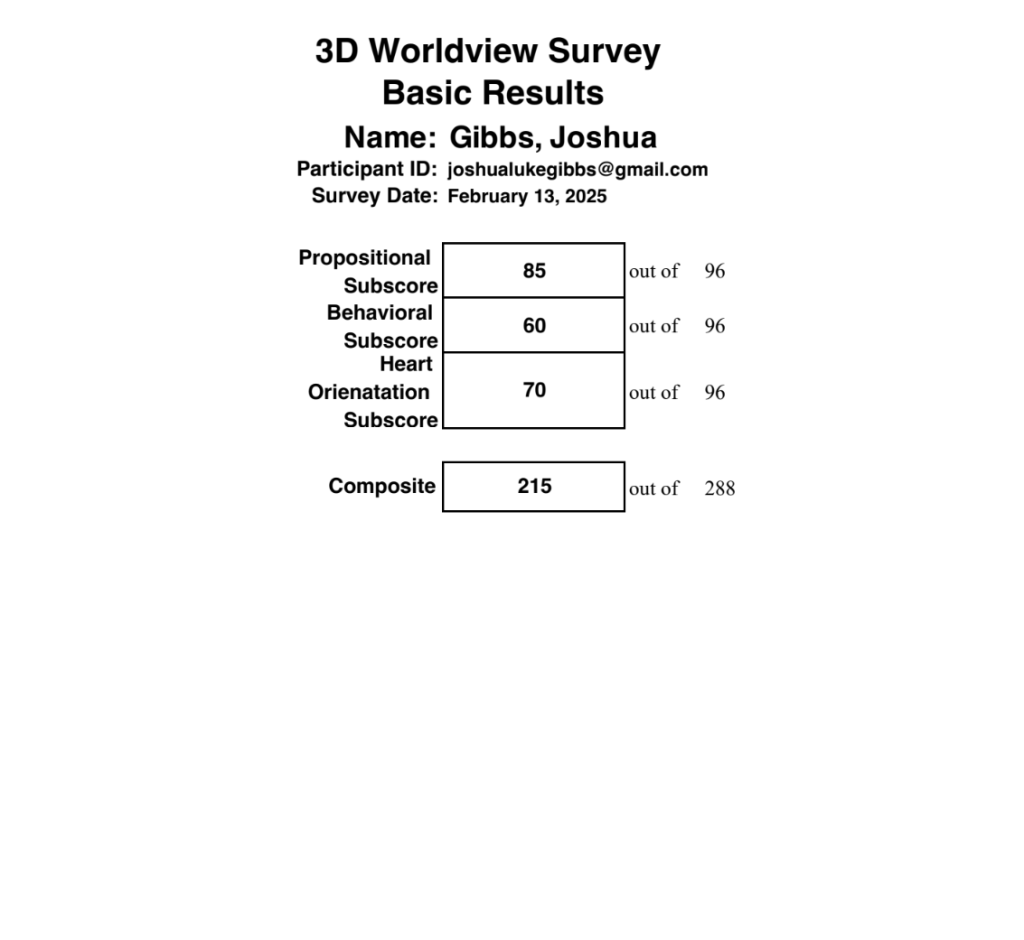
I received this via email this morning. I learned in this email that I could “upgrade” this assessment package to the $50 version at a discounted rate of just $10 more if I acted in the next seven days.
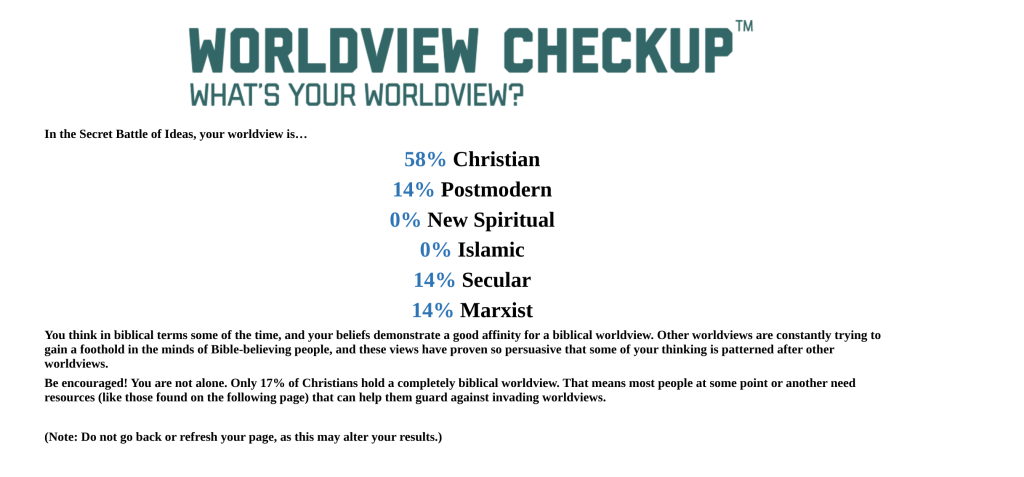
These are the results of the “Worldview Checkup,” which you can take here. The results are free and immediate, in case you are impatient.

 There are still faint glimmers of civilization left in this barbaric slaughterhouse that was once known as humanity.